American in Paris
George Gershwin
arr. Riko Higuma
Premiered in 1928, this iconic symphonic poem of Gershwin’s vivid musical depiction of Paris is a work with a full orchestration including (several) saxophones and even car horns! Very colorful, as one would expect from Gershwin’s orchestral works.
So, needless to say I was afraid that I might not only diminish this great piece of music but also not get the full essence by reducing it to only three instruments. I feared that the soundscape of a full orchestration had a lot to do with this music being incredibly charming and charismatic.
Just like with new compositions, you cannot really tell if the arrangement “works” or not until you perform it in front of a live audience—I very much remember the first performance of this arrangement in Boston. I was quite nervous for it but luckily we received a warm and positive response.
I realized that it has a lot to do with the fact that Gershwin is a master tune craftsman, and so I couldn’t really mess this up as long as I stayed focused on connecting the thread of the wonderful tunes he created.
Choosing what to cut out is always the most difficult part for me when making any arrangements because it’s obvious that composers put much thought into creating music that makes sense structurally. I had to be careful that I don’t completely change the flow of the piece but still cut out a chunk of it (Gershwin’s original is 20 min where mine is 8 min).
I decided to let go of many of the fast rhythmic sections but give enough time to explore the slow theme, giving everyone the chance to sing out the beautiful melody several times and made sure to include the wonderful counter melodies.
I couldn’t resist using the good old castanet to mimic the wood block off beats of this slow theme, to keep Gershwin’s ingenious way to give a little kick and extra charm to this lush melody.
I very often find his works irresistibly charming and I can only hope that I was able to keep that with this arrangement.
Note by Riko Higuma
Serenade for Three
Peter Schickele
My first encounter with Peter Schickele was in the mid-90s at a summer music camp, the Performing Arts Institute in Wilkes-Barre. While practicing in a choral room one day, I got a little bored and started rummaging through some LPs in a plastic crate next to the piano.
Amid an array of choral music, I stumbled upon a record titled “An Hysteric Return: PDQ Bach at Carnegie Hall with Professor Peter Schickele.” The cover alone—featuring a pompous-looking man in a wig—was strange enough, but the works listed below fully captured my attention: “Pervertimento for Bagpipes, Bicycle, and Balloons.”
What the hell was this? Little did I know that over 20 years later, I would be recording music by this wonderful composer.
Schickele’s “Serenade for Three” is, at least to us, a perfect encapsulation of Americana—a mix of rambunctious optimism, Copland-esque nostalgic beauty, and a raucous celebration of the human spirit. We thought rather than trying to explain this piece, we’d let Peter speak for himself:
“My brother started studying violin when he was nine, and I started playing clarinet and piano when I was a young teenager, so perhaps one of the reasons I was so delighted by the commission that resulted in Serenade for Three is that the piece recalls (in much more sophisticated form, I feel safe in saying) the sounds that wafted through 1354 N. 12th St., Fargo, North Dakota, during the late forties.
My brother ended up switching to viola, and I to bassoon, but I’ve always had a fondness for the clarinet/violin/piano combination, and it was high time I wrote something for it.
The first movement of the Serenade is a headlong series of dances set off by a robust refrain. The four sections (and three keys) of the lyrical second movement are tied together by the note E-flat which repeats in raindrop fashion throughout.
The finale features an interesting bit of incest. Peter Schickele writing variations on a theme by P.D.Q. Bach. The theme comes from the title character’s aria in Oedipus Tex, an opera/oratorio in one cathartic act.
I’ve always had a weakness for cornball cowboy music, which in the P.D.Q. Bach work gets combined with certain eighteenth-century classical figurations; the style in the Serenade finale is more wideranging: in addition to country fiddling, there’s also some boogiewoogie piano. A rabble-rousing finish.” — Peter Schickele
Note by Kliment Krylovskiy
Danzon No. 2
Arturo Márquez
arr. Riko Higuma
As the title suggests, this great masterpiece by Arturo Márquez pays tribute to the dance style of danzón from the Mexican state of Veracruz. Originally scored for a big orchestra including solo piano, an extensive percussion and brass sections, you usually see about 100 people on stage for the full-scale performance of this piece.
That being said, it starts out with only three instruments and by sheer luck, they are: solo clarinet, piano (so no need for any kind of arranging there, yay for me), and an instrument which has a very present voice—a clave! There was no way that I was not including that, so now we tour with a clave (thank you Vanessa for taking up this instrument!).
It’s worth noting that I decided to also use the castanet when this opening clave reappears, giving myself, the pianist, a double duty—left hand playing chords on the piano while right hand plays the castanet.
In fact, we all wear many hats—from the clarinetist playing as a soloist, to blending in as harmony in the background, to playing very loudly screaming on top of the register becoming the bright and shiny trumpet; and to the violinist also playing another instrument that is basically the third voice for the entire opening on top of representing the whole strings; and of course the pianist becoming an entire rhythm section while being everything else at the same time, as always.
Note by Riko Higuma
West Side Story
Leonard Bernstein
arr. Riko Higuma
Premiered in 1957, West Side Story reimagines Shakespeare’s Romeo and Juliet on the streets of mid-20th-century New York, where rival youth gangs—the Jets and the Sharks—collide amid themes of love, prejudice, and identity. Leonard Bernstein’s ingenious score fuses classical symphonic writing with jazz, Latin rhythms, and Broadway lyricism, and when paired with the words of the great Stephen Sondheim, it stands as a true masterpiece and an American treasure. The obvious challenge in creating this arrangement was condensing such an iconic and expansive score for just three instruments—made even more difficult by the task of selecting which numbers to include from a work filled with unforgettable music. In shaping this medley, I aimed to balance lyrical songs with rhythmic and energetic dance numbers. The result: Prologue, Somewhere, Cha-Cha, Maria, Cool, America, Procession, and Mambo. It was a true honor to arrange this remarkable work, and perhaps someday I will expand the medley further since I fully expect to be asked why every other beloved song was not included.
Note by Riko Higuma
Shocked Quartz (2021)
Greg Simon
Shocked quartz is a form of the mineral quartz which shows deformation on a microscopic, structural level. It begins as normal quartz, but under an extreme amount of pressure, its crystalline structure and appearance are permanently altered. Shocked quartz can be found in meteor impact craters, such as the Chicxulub crater; but scientists first discovered it following underground tests of nuclear bombs, whose detonation deformed quartz in the surrounding bedrock.
When I began writing this piece for the Zodiac Trio, the world was still grappling with the aftershocks of the COVID-19 pandemic; and the United States was reeling from a year of what felt like near-constant crisis, culminating in the U.S. Capitol riots of January 6, 2021. With each new event — the pandemic, the death of George Floyd, innumerable natural
disasters — it felt as if we had reached a new point of no return.
I began writing this piece with the shocked quartz phenomena in mind. My intention was to reflect on the past year: its chaos, its turmoil, and the sheer number of things that had seemingly changed forever after each new impact. I wanted to explore my emotions and anxieties around that time, around this sense that we could never undo the effects of these crises; and I wanted to see if I couldn’t find within these emotions a sense of determination and resolve.
Shocked Quartz begins with an explosion whose content contains all the seeds of musical material for the piece. While the explosion never returns, its effects are felt for the entirety of the work. Every gesture is derived from a handful of musical materials — a trichord, a rhythmic trope, a voicing strategy — present in the initial five seconds. As the piece
progresses, the music endeavors to leave the material and introduce new ideas, but is ultimately always pulled back into the parent material. The pressures of the explosion forever define the rules of the composition, and the music is trapped inside.
Note by Greg Simon
Tribute to Benny Goodman
Jean-Marc Brisson
As a clarinet-violin-piano trio, it’s no exaggeration to say that we’ve built our career around one of the greatest chamber music masterpieces of the 20th century: Béla Bartók’s legendary Contrasts.
Commissioned by none other than the King of Swing, Benny Goodman, this iconic piece has been central to our repertoire for nearly two decades. With over 150 performances to date, Contrasts has served as our lens into Goodman’s classical legacy. Each performance has been an opportunity to reflect on how a jazz legend ventured into the classical realm, inspiring a work of profound artistry.
Now, we’re thrilled to shift our focus to the side of Benny Goodman that defined him for the world: the King of Swing. With this project, we pay homage to his unparalleled influence on jazz with a collection of works popularized by Benny Goodman and His Orchestra.
To bring this vision to life, we’ve teamed up with the brilliant French jazz pianist and arranger Jean-Marc Brisson. Jean-Marc has taken some of Goodman’s most beloved jazz standards and reimagined them for clarinet, violin, and piano.
What makes these arrangements so unique is Jean-Marc’s ability to fully utilize the technical prowess of classical musicians while juxtaposing it with the trademark flourishes and licks of jazz. The result is a collection of arrangements that sparkle with virtuosity, come alive with masterful improvisation (all meticulously written out!), and even include delightful classical Easter eggs—listen closely, and you might catch a hint of Peer Gynt in “Dinah.”
Additionally, Jean-Marc’s innovative use of polyrhythms in a piece like “In A Sentimental Mood” adds another dimension to these arrangements, bringing these famous tunes to life while tipping the hat to the trio’s and Jean-Marc’s classical roots.
Note by Vanessa Mollard

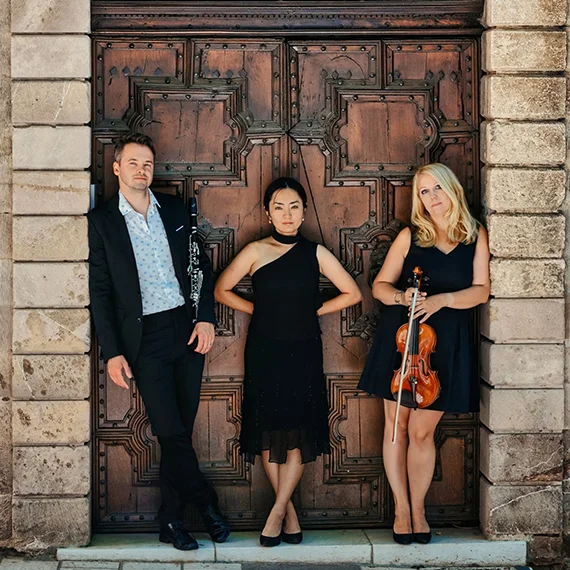
 KLIMENT KRYLOVSKIY, CLARINET
 VANESSA MOLLARD, VIOLIN
 RIKO HIGUMA, PIANO